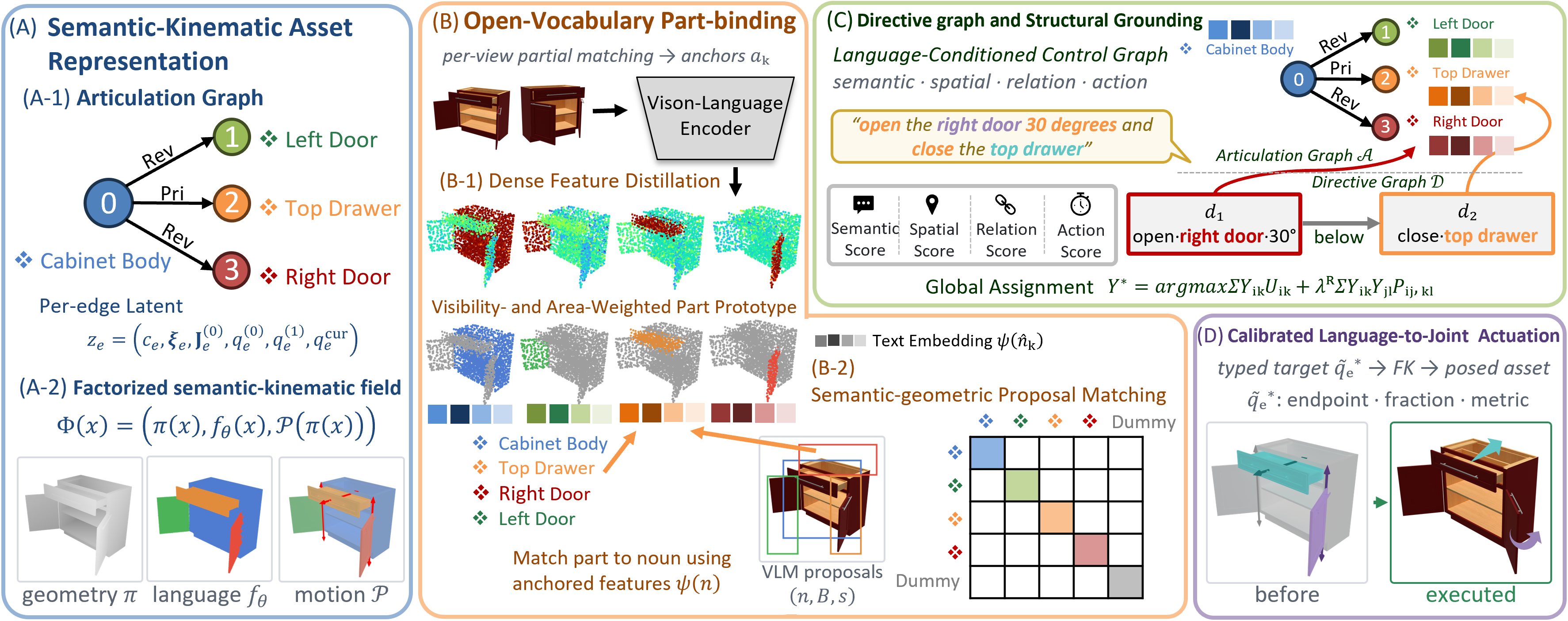
Addressing an articulated object in language raises three challenges. 1. Repeated parts: a cabinet has several doors and drawers that share one noun, so “the door” is ambiguous on its own. 2. Spatial ambiguity: same-noun parts must be told apart by position or relation — is “the drawer below the top drawer” the second drawer? 3. Motion semantics: open, close, and halfway must map onto each part's actual joint and calibrated motion range. ArtLang treats all three as one graph-to-graph binding: the command is parsed into a directive graph of entities, qualifiers, and relations, and grounded onto the reconstructed articulation graph by a global assignment over semantic, spatial, relational, and action compatibility — so “close everything” actuates every movable part, while “close the left and right doors” selects exactly the two doors and leaves the drawer at rest.
From a mesh (or capture) and its observed states to a language-controllable asset. ArtLang is a graph-to-graph pipeline from language to an articulated object's semantic and kinematic structure. (A) A part-aware reconstruction (ArtMesh backend) is represented as an articulation graph with a factorized semantic-kinematic field: every surface point carries its part identity, a distilled language feature, and the graph-constrained motion of its part. (B) Open-vocabulary features and VLM part proposals are bound to persistent parts by semantic-geometric partial matching, giving each part a noun and an FG-CLIP-2 anchor. (C) A typed parser turns the command into a directive graph, which is globally grounded against the articulation graph under semantic, spatial, relational, and action compatibility, with support for null assignments and abstention under ambiguity. (D) Accepted directives are converted to calibrated joint targets inside the observation-supported interval and executed by forward kinematics.
Free-form commands are resolved into (part, joint coordinate) targets and executed as rigid motions — spatial qualifiers disambiguate same-noun parts (left / right / top), magnitude modifiers and explicit angles map onto the calibrated joint interval, multi-directive sentences ground globally, and relational references resolve against the graph. Each clip shows the command and the resulting actuation of the reconstructed model. (Articulate-100 objects are captured with state 0 open, so commands typically close a part.)
Given only a mesh and a single-view image of the end state, ArtLang recovers the full articulated object — parts, joints, and the language handle.
The articulation coordinate supports continuous control beyond the observed states: a directive selects a part and any value of the actuation parameter t places it along its learned trajectory — t = 0 is the rest state, t = 1 the learned closed state, and negative values extrapolate past the rest pose in the opening direction, through poses never seen at training. Each clip sweeps one part while all others stay at rest; because t scales the learned motion, the sweep doubles as a visual audit of the recovered kinematics.
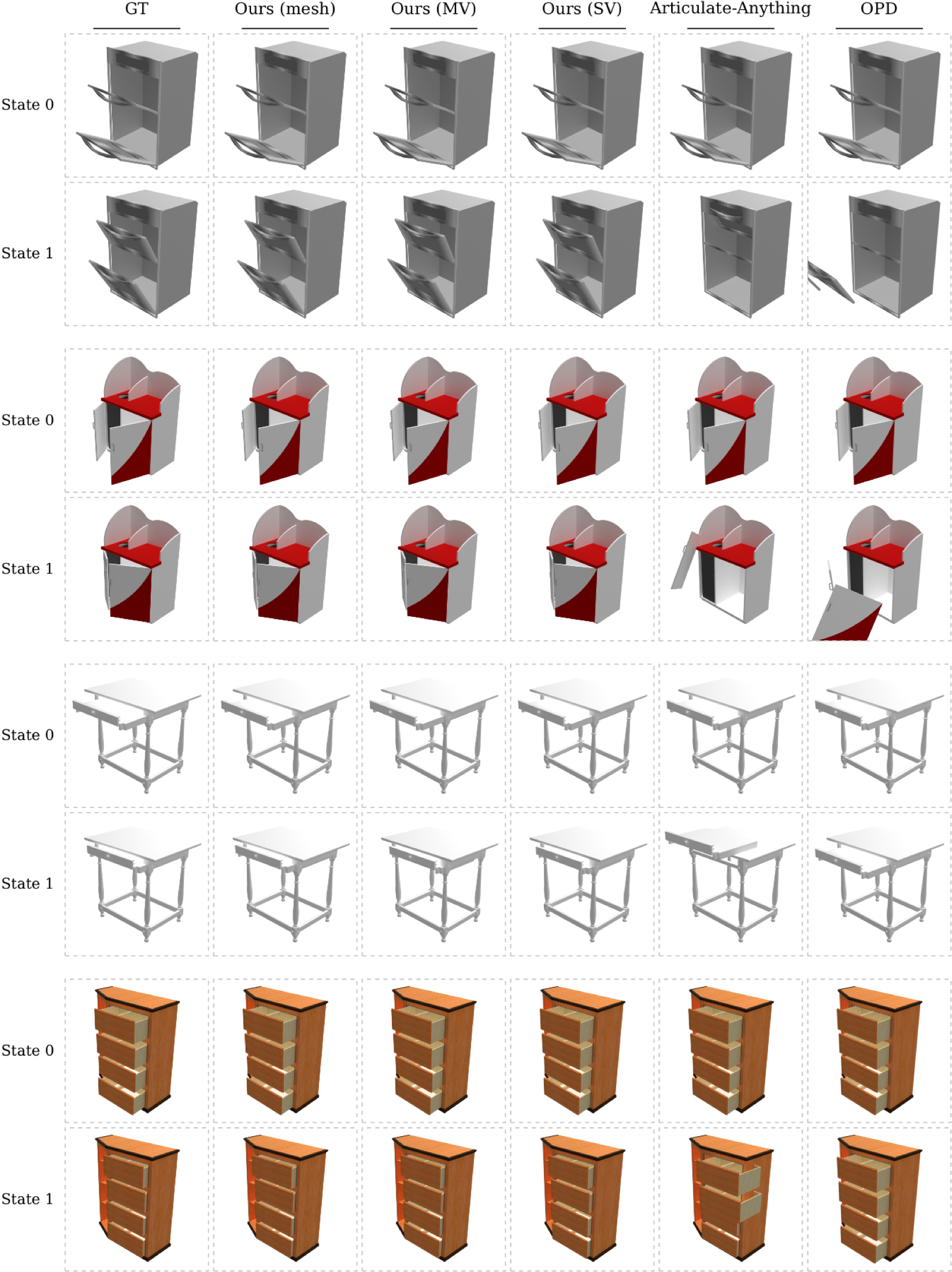
Commanded actuation compared against the ground truth and prior systems. Baselines either miss the referred part (spatially unaware grounding), cannot address the language at all, or actuate with an incorrect motion — ArtLang's global graph-to-graph assignment selects the right part and moves it along the right joint.
Reconstructing from multi-view observations of the two states, ArtLang matches its ArtMesh backbone on joints and geometry — attaching the language handle costs no reconstruction quality.
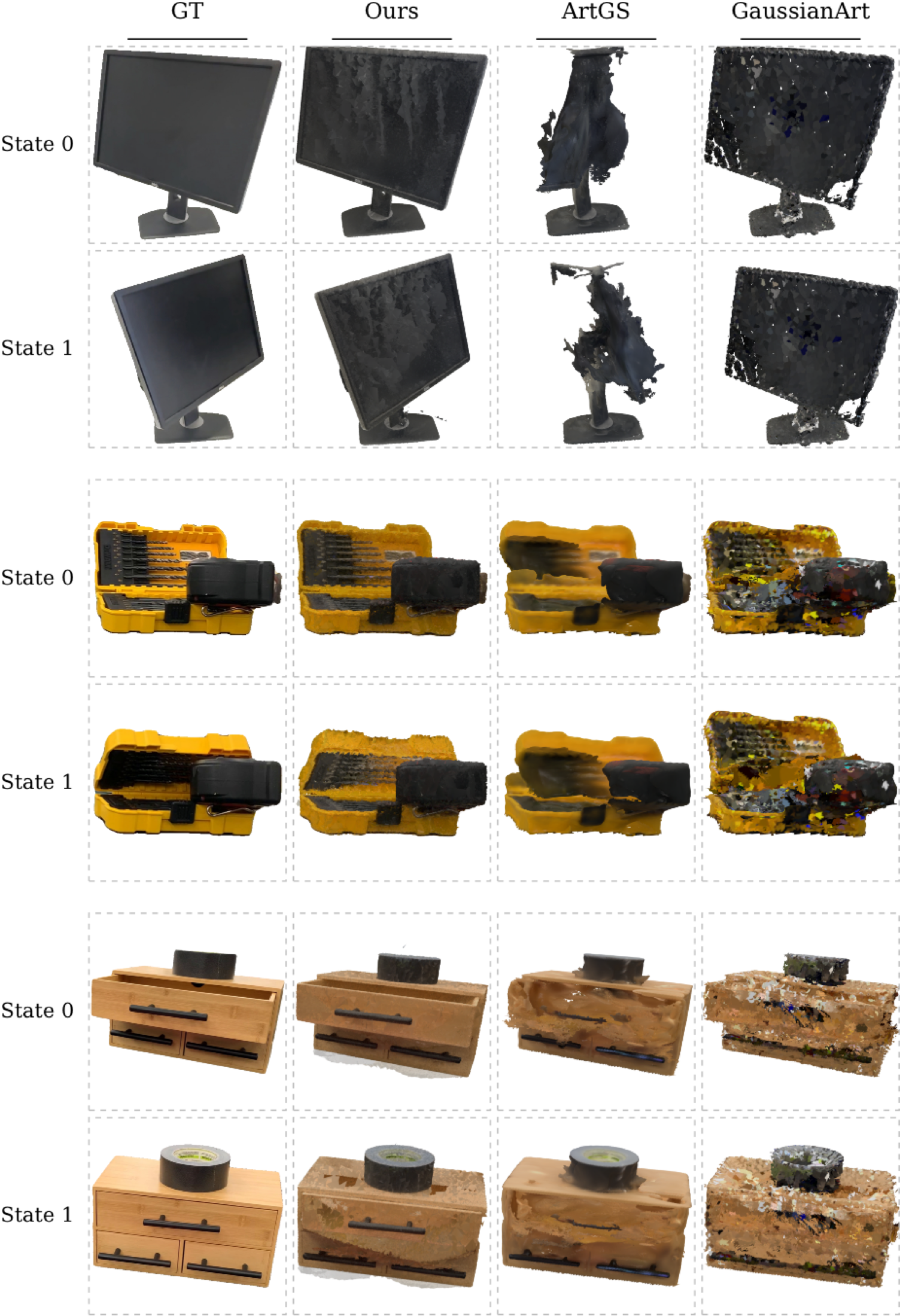
The same pipeline applied to real SplArt objects: despite noisier geometry and less clean boundaries than the synthetic set, the semantic and spatial axes still resolve the intended part, and the motion axis actuates it along the recovered joint — a user can address a captured object without touching a joint index.
@article{artlang2026,
  title   = {ArtLang: Structured Language-to-Kinematics Grounding for
             Articulated 3D Actuation},
  author  = {Anonymous Authors},
  journal = {Under review},
  year    = {2026}
}